Roof Leak Repair in Valdosta, GA
Leak tracing and repair for Valdosta and Lowndes County homes — shingle, metal and low-slope roofs.
- Most Valdosta calls reach a roofer the same day
- Licensed local roofers
- Calls answered 24/7
Calling…
(229) 555-0100Tap to call againDidn't open? Dial (229) 555-0100. Have your ZIP code handy.
What to do in the next 10 minutes
- Put a container under it, then pierce the bulge If the ceiling is sagging or bulging, water is pooling behind the drywall. Put a bucket down and poke a small hole at the lowest point of the bulge with a screwdriver. It feels wrong, but a controlled drain is far cheaper than a ceiling collapse.
- Photograph everything before you move it Wide shots of the room, close shots of the stain, and the ceiling from directly underneath. If this turns into an insurance claim, photos taken before cleanup are the difference between a paid claim and a denied one.
- Move electronics and switch off the circuit Water tracks along joists and can reach light fixtures and outlets well away from the visible drip. If water is anywhere near a fixture or outlet, kill that circuit at the breaker.
- Get belongings and furniture clear Move what you can, cover what you can't. Water from a roof leak carries insulation fibres, shingle granules and whatever was in the attic — it stains far worse than clean water.
- Stay off the roof Wet asphalt shingles are extremely slick, and a roof that is already leaking may have soft decking underneath. More people are hurt inspecting a leak than by the leak itself. Let someone with fall protection go up.
- Note the weather when it leaks Does it only leak in wind-driven rain? Only after a long soak? Only in the afternoon storms? Tell the roofer — it narrows the source fast and can save an hour of diagnostic time.
Why Valdosta roofs leak
Valdosta sits in a humid subtropical belt that gets roughly 50 inches of rain a year, most of it in summer afternoon thunderstorms and tropical systems tracking up from the Gulf. That volume is the backdrop, but it is rarely the cause on its own. Four things put water through a Lowndes County roof.
Pine debris in valleys and gutters. This is the most common cause of a slow, recurring leak on an otherwise healthy Valdosta roof, and it is almost entirely preventable. South Georgia is heavy pine country. Needles pack into roof valleys and gutter lines, then hold moisture against the shingle surface for days after the rain stops. Water that should run down the valley gets pushed sideways, under the shingle course, and finds the nail line. Homes backing onto pine stands off Val Del Road or out toward Kinderlou see this constantly.
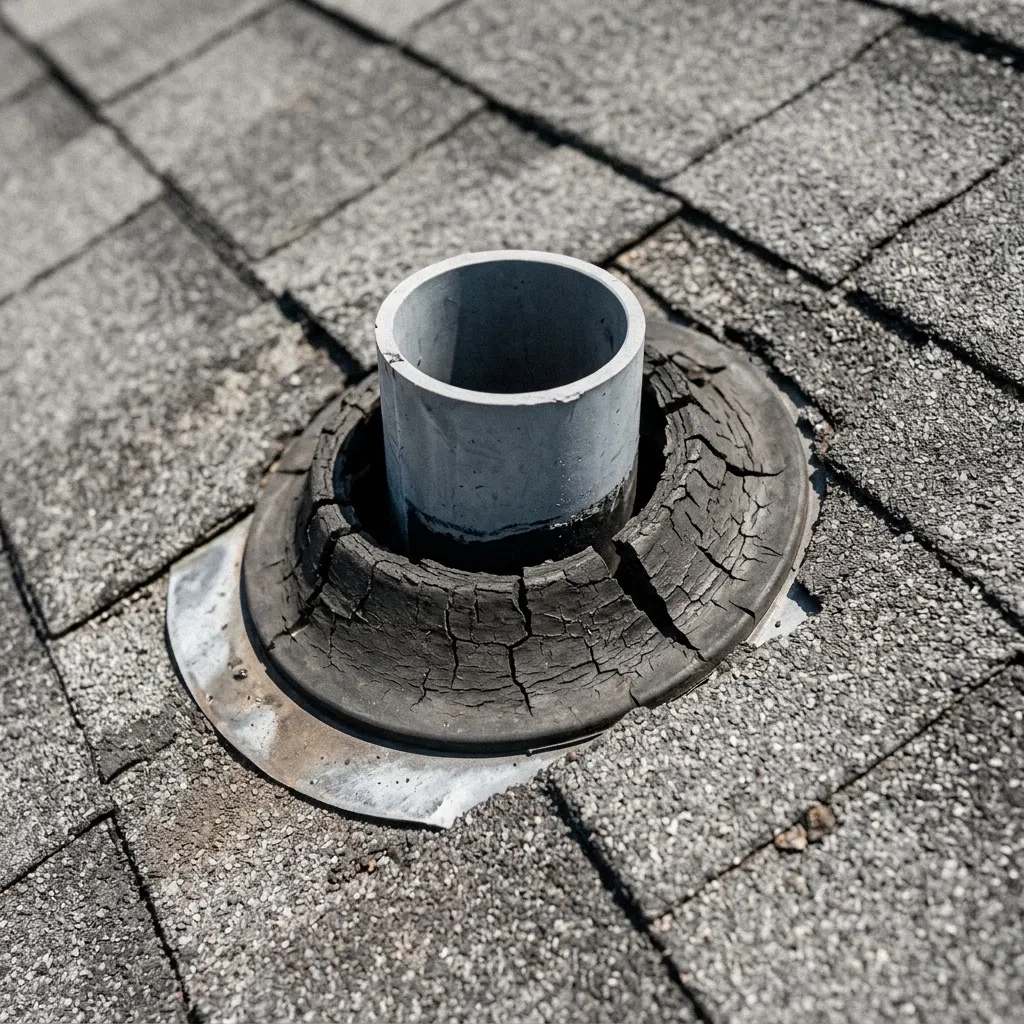
Thermal cycling. Summer highs in the low-to-mid 90s push dark shingle surfaces far above the ambient air temperature, and then an afternoon storm cools them in minutes. That daily expansion and contraction is what cracks sealant beads around pipe boots, splits the rubber collars outright, and slowly backs roofing nails out of the decking. Pipe boot failure is the single most common repair call on Valdosta roofs between eight and fifteen years old.
Wind uplift from tropical systems. Valdosta is far enough inland to be spared storm surge, but well within reach of tropical system winds. Hurricane Helene in September 2024 did significant wind damage across south Georgia and left a repair backlog across Lowndes County; Idalia in 2023 and Michael in 2018 both brought damaging wind to the region. Uplift often loosens shingles along rake edges and ridges without visibly tearing them off — which means the damage is invisible from the ground and shows up as a leak months later, long after the storm everyone would have blamed.
Flashing, which is where most leaks actually are. Chimneys, skylights, wall-to-roof transitions, dormers and plumbing penetrations are where two materials meet, and that junction is what fails. A roof field can be in excellent condition while a six-inch stretch of step flashing lets water in every time it rains from the southwest.
Where the water gets in versus where you see it
The stain on your ceiling is almost never underneath the hole.
Water enters the roof, hits the decking, and then travels — along the underside of the sheathing, down a rafter, across the top plate of a wall — until it reaches something that lets it drop. On a typical Valdosta roof pitch, a leak can surface eight to fifteen feet from where it entered. It is entirely normal for water to come through a hallway ceiling when the actual failure is a pipe boot on the other side of the ridge.
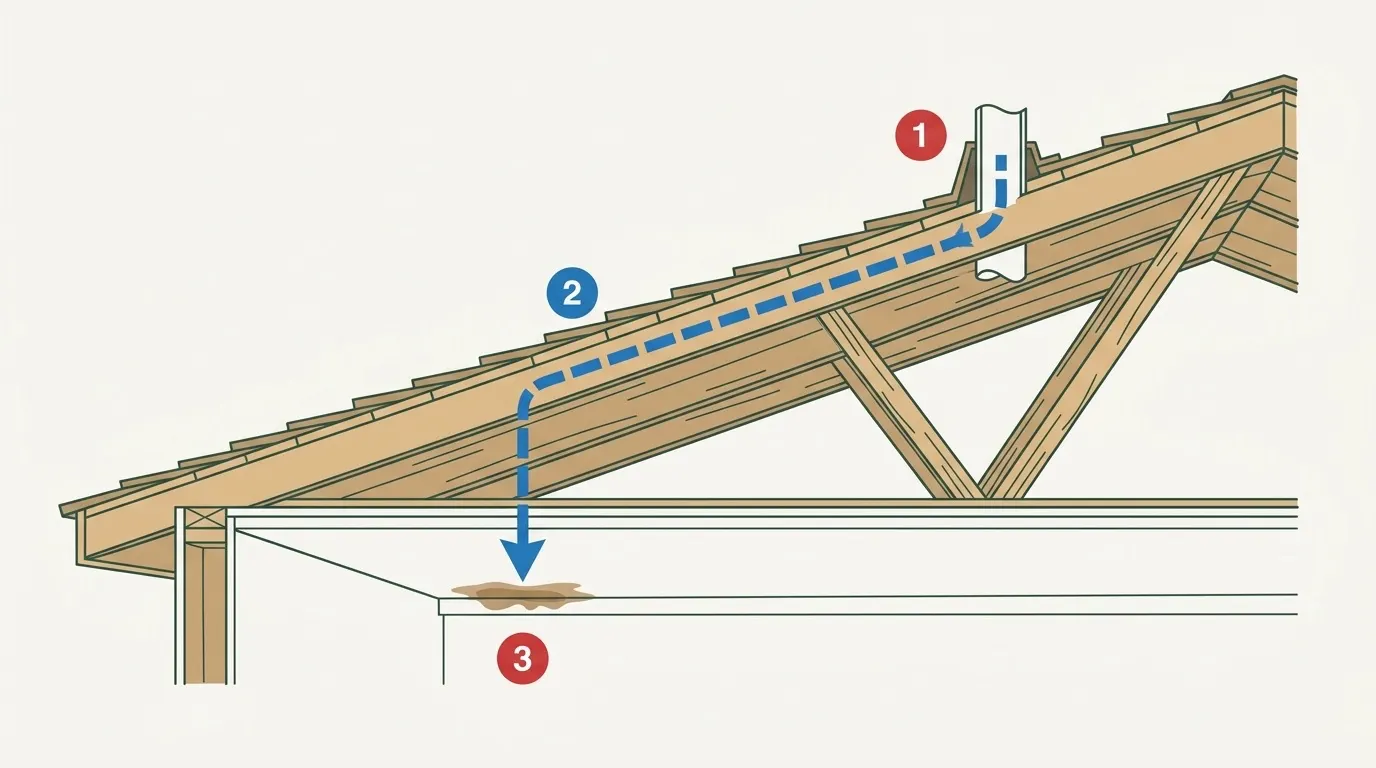
- 1Water enters hereA failed pipe boot high on the slope. Nothing about this is visible from inside the house.
- 2It travels along the underside of the deckingRunning down the sheathing, along a rafter, across a wall top plate — until it reaches something that lets it drop.
- 3You see it here, often 8–15 feet awayWhich is why patching directly above the stain so often fails. The entry point is somewhere else entirely.
This is the whole reason a leak trace matters more than the patch. Any roofer can seal a hole. Finding the right hole is the skill, and it is the reason repairs sometimes fail: the visible symptom got patched while the real entry point upslope kept letting water in.
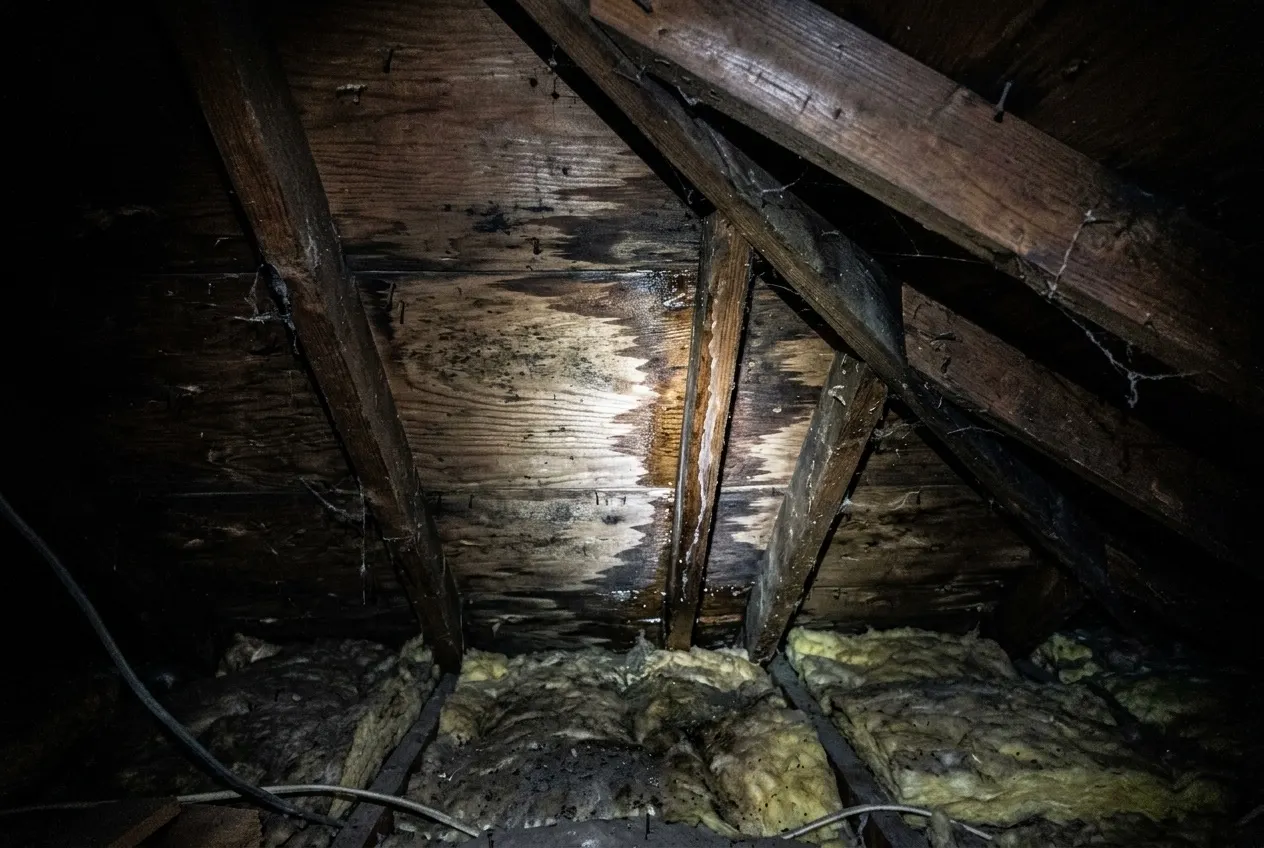
A proper trace works in three stages — interior stain, then attic, then roof surface. The attic stage is the one people skip and the one that actually answers the question, because wet decking and water staining on the underside of the sheathing point straight back up to the entry.
Warning signs worth acting on
Some of these mean call today. Others mean call this month, before the afternoon storms turn a small problem into a decking replacement.
- Ceiling or wall stains, especially ones with a defined brown ring — a ring means it has dried and re-wetted repeatedly, so the leak is not new
- Shingle granules collecting in gutters or at downspout splash blocks, which indicates the shingle surface is wearing through
- Daylight visible through the roof decking from inside the attic
- A musty smell in the attic or upstairs rooms, often the first sign of a slow leak that has been running for months
- Sagging or spongy spots underfoot on the roof, meaning the decking is already saturated
- Cracked or torn rubber collars around plumbing vents — in this climate these fail well before the shingles do (this is what one looks like:)
- Lifted or curled shingle tabs along rake edges and ridges after a wind event
- Bubbling or peeling paint on an interior wall below the roof line
- Sagging or detached gutters, which back water up under the shingle course at the eave
What a repair actually involves
For a straightforward single-point leak — a failed pipe boot, a cracked sealant bead, a handful of wind-lifted shingles — expect two to four hours on site. The roofer removes the shingles around the entry point, checks the decking underneath, replaces the failed component, and reseats the shingle course with new underlayment and fasteners.
Where it gets longer and more expensive is wet decking. If the leak has been running for a while, the plywood or OSB sheathing beneath it will be soft, delaminated or rotted, and it cannot simply be roofed over. The damaged sheets have to be cut out and replaced before the roof is closed up. This is why a leak you have been living with for two seasons costs several times what the same leak would have cost in the first month — and it is the single best argument for calling early.
Two things worth insisting on. First, ask to see photos of what was found, not just what was fixed. Second, ask for a water test before the crew leaves — a hose run over the repaired area for several minutes, with someone watching from the attic. A repair that has not been tested has not been verified.
Be careful about replacement pressure
Most Valdosta leaks are repairs, not replacements. If a contractor quotes a full roof replacement before locating the leak source, that is worth a second opinion.
There are genuine cases for replacement — a roof past twenty years, widespread granule loss, multiple simultaneous leaks, decking rot in several areas. But “you need a whole new roof” delivered from the driveway, without an attic inspection, is a sales position rather than a diagnosis. Get the leak found first. Then decide.
This matters more in the months after a storm. A large storm event draws out-of-area crews, and the ones working on volume have an incentive to convert every leak call into a replacement claim. Local roofers who will still be in Lowndes County next year generally behave differently.
Choosing a roofer in Valdosta
Georgia does not issue a standalone roofing licence. Contractor licensing runs through the Georgia State Licensing Board for Residential and General Contractors and applies above certain job thresholds, so the licence question alone will not tell you much about a repair-sized job.
These will:
- General liability insurance and workers’ compensation — ask for certificates, not assurances. If an uninsured worker is hurt on your roof, that can land on your homeowners policy.
- A local physical address, not just a phone number. After a storm, the out-of-area crews leave and the warranty leaves with them.
- A written workmanship warranty on repairs, not only on replacements.
- Photo documentation of the diagnosis before work begins.
- A written quote before work starts, with the scope described specifically enough that you could hold them to it.
Roof Leak Repair costs in Valdosta
What this work typically costs locally. Ranges are for planning, not quotes — the only accurate number comes from an inspection.
| Repair type | Typical Valdosta range | What moves the price |
|---|---|---|
| Single-point leak repair | $300 – $900 | Access, one entry point, no decking damage |
| Flashing or chimney reseal | $250 – $750 | Chimney condition, height, flashing type |
| Roof valley repair | $400 – $1,200 | Valley length, pine debris damage, underlayment condition |
| Decking replacement | $70 – $150 per 4x8 sheet | Extent of rot, attic access |
| Full leak trace and multi-point repair | $500 – $2,000 | Number of entry points, water travel distance |
Ranges reflect typical Valdosta-area pricing for single-story asphalt shingle roofs in accessible condition. Steep pitch, two-story access, hidden decking damage and after-hours calls all push costs higher.
Repair, partial replacement or full replacement?
Most Valdosta leaks are repairs. Be cautious with anyone who quotes a full replacement before finding the leak source.
| Option | When it makes sense | Typical Valdosta cost | Lifespan added |
|---|---|---|---|
| Targeted repair | One or two entry points, roof under about 15 years old, decking sound | $300 – $900 | Restores remaining roof life |
| Section or slope replacement | Damage confined to one slope, or storm damage on the windward side | $1,800 – $6,000 | New life on that section only |
| Full replacement | Roof over about 20 years, widespread granule loss, multiple leaks, decking rot in several areas | $9,000 – $22,000 | 20–30 years |
| Overlay (second layer) | Rarely advisable in this climate — traps heat and hides decking problems | $6,000 – $12,000 | 10–15 years, and complicates the next tear-off |
How it works
- Call and describe it Where the water shows up inside, when it started, and what the weather was doing. Two minutes on the phone usually narrows the likely cause to one or two things.
- On-site leak trace Water rarely enters where it appears. A proper trace works backwards from the interior stain, up through the attic to find the wet decking, then onto the roof to find the actual entry point.
- Documented findings and a written quote Photos of what was found, what is causing it, and a written price before any work starts. If it looks like an insurance claim, this is the documentation the adjuster will want.
- The repair Most single-point repairs are a few hours. Anything involving wet decking takes longer because the damaged sheathing has to come out before the roof can be closed up.
- Water test and warranty A proper repair is hose-tested before the crew leaves. Ask for the workmanship warranty in writing — reputable local roofers give one on repairs, not just replacements.
Insurance claims
If your leak came from wind, hail, a fallen limb or a tropical system, it may be a covered claim rather than an out-of-pocket repair. Georgia policies generally cover sudden damage and exclude wear and age, and the documentation you gather in the first hour is usually what decides which side of that line your claim lands on.
Frequently asked questions
How much does roof leak repair cost in Valdosta, GA?
Most roof leak repairs in Valdosta run $300 to $900. A single-point repair on an accessible shingle roof — one flashing, one pipe boot, a few shingles — typically lands at $300 to $600. Repairs that require replacing wet decking usually run $700 to $2,000 because the damaged sheathing has to be cut out and replaced before the roof is closed. After-hours and emergency call-outs add roughly $100 to $300. Validate current local pricing with your contractor before budgeting.
How fast can someone get out to a leaking roof in Valdosta?
For an active leak, most Valdosta roofers will get someone out the same day, and often within a few hours. The exception is the two or three days right after a major storm, when every roofer in Lowndes County is triaging calls — in that window, expect a tarp first and the permanent repair scheduled behind it.
Will my homeowners insurance cover a roof leak?
It depends on the cause, not the damage. Sudden events — wind, hail, a fallen limb, a tropical system — are generally covered. Leaks traced to age, wear or deferred maintenance are generally excluded, and that exclusion is where most Valdosta claims get denied. Photograph everything before cleanup, keep every invoice including any tarping, and report the claim promptly.
Why does my roof only leak sometimes?
Intermittent leaks almost always mean the entry point needs specific conditions to let water in. Wind-driven rain from one direction points to flashing or a rake edge. A leak that only shows after hours of steady rain usually means water is backing up behind debris in a valley or gutter. A leak that appears on hot, still days is often condensation, not a roof leak at all.
Can a roof leak be repaired in the rain?
A temporary fix can — tarping or a sealant patch will stop water getting in and buy time. A permanent repair needs a dry deck, because sealing wet sheathing traps the moisture and causes rot. In practice a Valdosta roofer will tarp during the storm and come back to do the real repair once it passes.
How long should a roof leak repair last?
A properly diagnosed and executed repair should last the remaining life of the roof. Repairs that fail within a year almost always mean the original leak was never actually found — the visible symptom was patched while the real entry point upslope kept letting water in. This is why the leak trace matters more than the patch.
Do I need a licensed contractor for roof repair in Georgia?
Georgia does not issue a standalone roofing licence, but contractor licensing is administered by the Georgia State Licensing Board for Residential and General Contractors and applies above certain job thresholds. Regardless of the threshold, confirm any roofer carries general liability insurance and workers' compensation before they set foot on your property — if an uninsured worker is injured on your roof, that can become your problem.
Areas we cover
Valdosta and Lowndes County, plus surrounding towns. ZIP codes 31601, 31602, 31605, 31606, 31698.
Related guides
How Much Does Roof Leak Repair Cost in Valdosta, GA?
Most roof leak repairs in Valdosta run $300 to $900. Here is what sits behind that range, what pushes a job to the top of it, and the one variable that matters more than all the others.
Does Homeowners Insurance Cover Roof Leaks in Georgia?
Georgia homeowners policies generally cover sudden damage and exclude wear. Nearly every denied roof claim turns on which side of that line the insurer puts your leak — and documentation is what decides it.
Roof Leak or Attic Condensation? How to Tell the Difference
In humid south Georgia, a real share of reported roof leaks are attic condensation. Same stain, same damp insulation, completely different fix — and roof repair will not solve it.
Roof leaking in Valdosta?
Tell us what's happening and we'll put a licensed local roofer on it. Calls are answered around the clock.
Calling…
(229) 555-0100Tap to call againDidn't open? Dial (229) 555-0100. Have your ZIP code handy.