Roof Leak or Attic Condensation? How to Tell the Difference
In humid south Georgia, a real share of reported roof leaks are attic condensation. Same stain, same damp insulation, completely different fix — and roof repair will not solve it.
Not every ceiling stain is a roof leak. In humid south Georgia, a real share of calls that come in as roof leaks turn out to be attic condensation — and no amount of roof repair will fix one.
The two produce almost identical symptoms: a ceiling stain, damp insulation, a musty smell upstairs. Telling them apart before you pay anyone to get on the roof is worth doing.
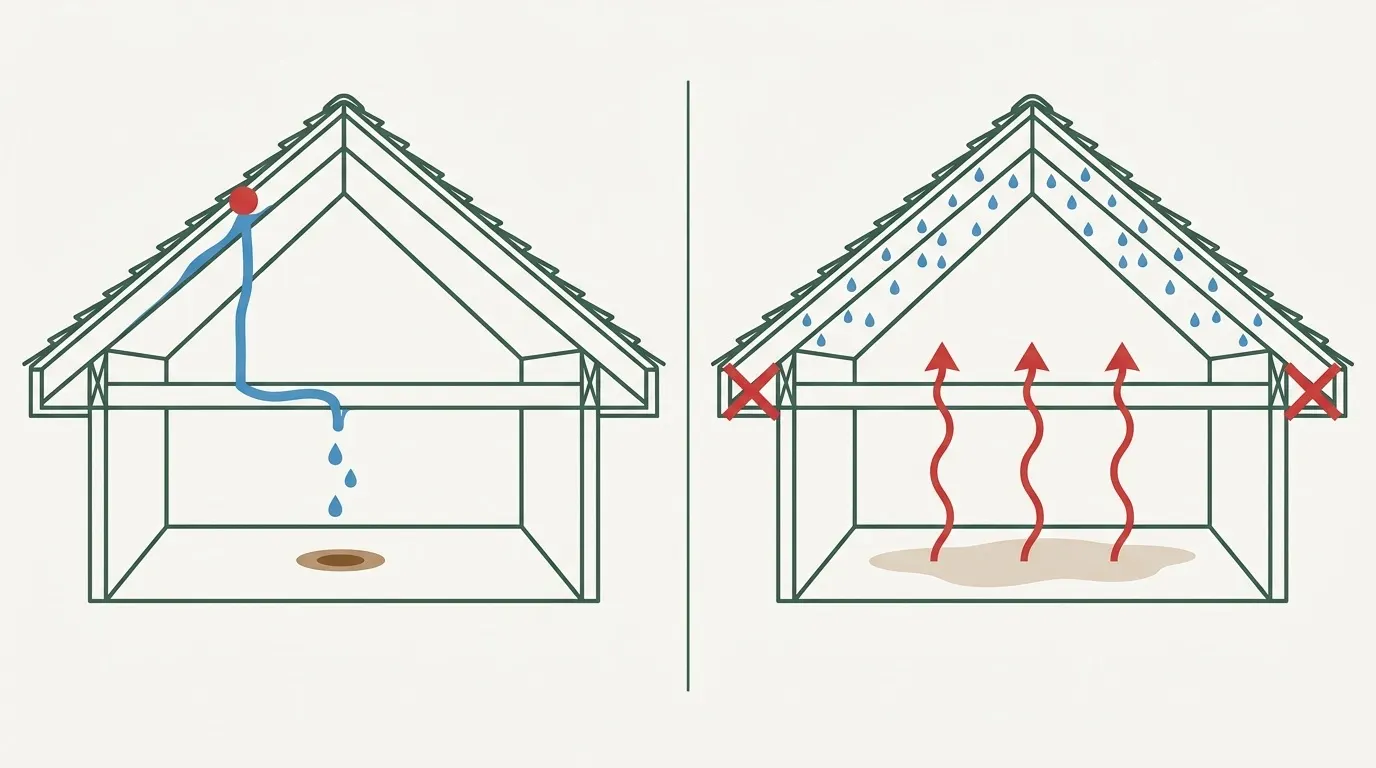
- LA leak has one wet pathTrace it up the decking and it leads back to a single entry point. It tracks with rainfall.
- CCondensation is uniformMoisture across the whole underside of the decking, often with beads on the nail points. It tracks with humidity, not rain.
- LDefined stain, often with a ringA ring means it has dried and re-wetted repeatedly.
- CBroad, diffuse damp patchesFrequently spread across several rafter bays, with blocked soffit vents as the root cause.
The quick comparison
| Roof leak | Attic condensation | |
|---|---|---|
| When it appears | During or shortly after rain | Humid weather, big temperature swings — often with no rain at all |
| Stain shape | Defined, often with a brown ring | Broad, diffuse, frequently across several rafter bays |
| In the attic | A wet trail leading back up to one entry point | Uniform dampness or droplets across the whole underside of the decking |
| Decking appearance | Wet in one path or area | Evenly damp, sometimes with frost-like crystals in winter |
| Nails | Normal | Often rusty or beaded with moisture on the pointed ends |
| Seasonality | Follows the rain | Worst in humid summer and in cold snaps |
| The fix | Roof repair | Ventilation and moisture control |
| Typical cost | $300 – $900 | $150 – $800 |
Why condensation happens
Warm, moist air rises into the attic. It meets the underside of the roof decking, which is cooler. The moisture condenses out onto that surface, exactly the way a cold glass sweats on a summer afternoon.
Enough of it collects and it drips onto the insulation below, saturating it. Saturated insulation stops insulating and eventually shows through as a ceiling stain.
Three things make it worse, and south Georgia has all three:
High ambient humidity. Valdosta’s climate keeps a lot of moisture in the air year-round. The low ground south of the city toward Grand Bay is worse still.
Inadequate ventilation. An attic needs both intake at the soffits and exhaust at or near the ridge. If soffit vents are blocked — frequently by insulation pushed into them during an upgrade — air cannot move and moisture cannot leave.
Moisture sources inside the house. Bathroom extractor fans and clothes dryers vented into the attic rather than through the roof. This is more common than people expect, particularly in homes where bathrooms were remodelled at some point.
The three-minute attic check
Go up with a torch, ideally in the morning after a humid night.
Look at the underside of the decking. Is there one wet path, or is the whole surface damp? A single wet trail is a leak. Uniform dampness across multiple rafter bays is condensation.
Look at the nail points. The roofing nails coming through the sheathing are the coldest points in the attic, so they condense first. Rusty nails, or beads of water hanging off the nail tips, are a strong condensation signal.
Follow the water upwards. If you can trace a wet line up the decking to a specific point — a pipe penetration, a valley, a nail hole — that is a leak with an entry point.
Check the soffits. From inside, can you see daylight at the eaves, or is insulation packed against them? Blocked soffit vents are the most common cause of the whole problem.
Check where the bathroom and dryer vents terminate. If either discharges into the attic space rather than through a roof or wall vent, you have found your moisture source.
One test that settles it
If you are still unsure, wait for weather.
Dry, humid spell: if damp appears with no rain at all, it is condensation. Heavy rain after a dry period: if damp appears only then and only in one spot, it is a leak.
You can also run a hose over the suspected area for ten to fifteen minutes on a dry day while someone watches from the attic. Water appearing means a leak. Nothing appearing, on a roof that stains in humid weather, means condensation.
It can be both
Worth saying, because it is common on older roofs: a small leak lets moisture into the attic, raising humidity, which then causes condensation across a much larger area. Fixing the leak without also fixing the ventilation leaves you with a smaller version of the same problem.
A proper diagnosis looks at both.
Why this matters financially
Condensation is generally cheaper to fix than a roof leak — often $150 to $800 for ventilation work against $300 to $900 for a roof repair.
But the more important point is that a roof repair will not fix condensation. If you pay for a repair, the stain comes back, and it looks like the repair failed. People then pay for a second repair, and sometimes a third, chasing a problem that was never on the roof.
Two other things worth knowing:
Insurance almost never covers condensation damage. It falls squarely under maintenance and humidity exclusions.
Left alone, it causes real damage. Persistent attic moisture leads to mould on the sheathing, rotted decking, corroded fasteners, and insulation that has permanently lost its R-value. It is slower than a leak, but it is not harmless.
If you have worked through this and it does look like a genuine leak, roof leak repair covers what the diagnosis and repair involve.