Storm Damage Roof Repair in Valdosta, GA
Wind and tropical system damage assessment, documentation and repair for Lowndes County properties.
- Documented damage assessment your adjuster will accept
- Licensed local roofers
- Calls answered 24/7
Calling…
(229) 555-0100Tap to call againDidn't open? Dial (229) 555-0100. Have your ZIP code handy.
What to do in the next 10 minutes
- Photograph everything before you touch anything Wide shots of the property, the roof from the ground on all four sides, every interior stain, and any debris where it landed. Your insurer's adjuster may not arrive for days. These photos are the record of what the damage looked like before weather and cleanup changed it.
- Note the date and time of the storm Claims are assessed against a specific weather event. Write down when it hit. If you have a doorbell camera or security footage of the storm, save and back it up now — that is unusually strong evidence.
- Get a tarp on it if water is coming in Most policies contain a duty to mitigate — a requirement to take reasonable steps to prevent further damage. Tarping satisfies it, and the tarping cost is usually reimbursable. Keep the invoice.
- Do not throw away damaged material Keep torn shingles, damaged fascia, the limb that hit the roof. Adjusters routinely ask to see physical evidence, and it is much harder to argue about damage you can put in front of someone.
- Report the claim promptly, before you commit to repairs Most policies require prompt notice. File first, then schedule permanent work. Authorising a full repair before the adjuster has seen it can complicate what gets paid.
- Be cautious with door-knockers Large storms draw out-of-area crews into Lowndes County within days. Some are legitimate. Do not sign anything on your doorstep, especially a document that assigns your insurance benefits to a contractor.
What south Georgia storms actually do to roofs
Valdosta does not get the storm surge that coastal Georgia deals with. What it gets is wind — tropical system winds reaching a hundred miles inland, plus the severe thunderstorm downbursts that come through most summers.
Wind damage on an asphalt roof is frequently invisible from the ground, and this is the thing homeowners most often get wrong. Shingles are sealed to each other by an adhesive strip that softens in heat and bonds the course below. Uplift breaks that seal without necessarily removing the shingle. Afterwards the roof looks entirely normal, but every shingle in the affected area is now loose, and the next moderate storm drives rain straight underneath it.
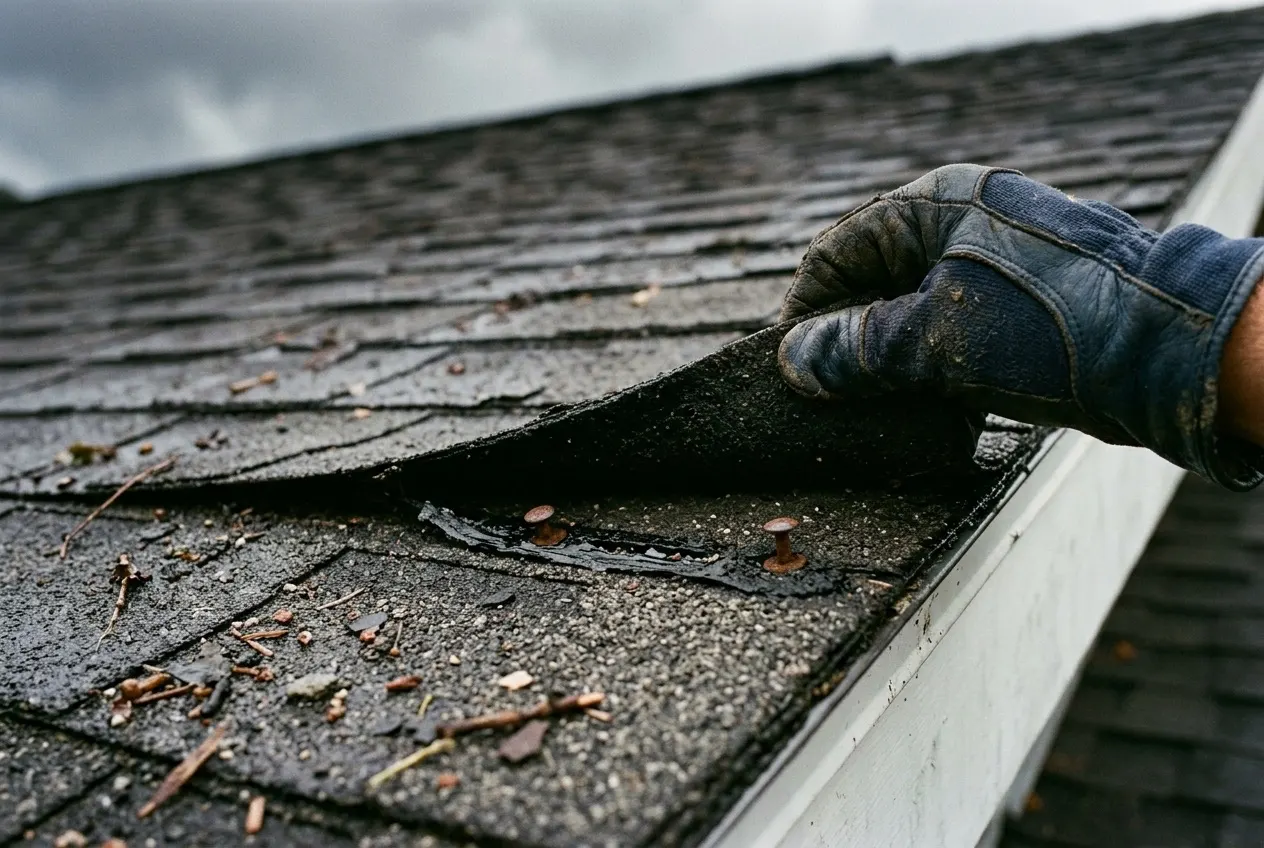
This is why storm-related leaks so often appear weeks or months after the storm itself — and why homeowners end up arguing with an adjuster about whether the damage is storm-related at all. The seal broke in September. The leak arrives in November. By then the insurer is asking why you waited.
Hurricane Helene in September 2024 produced this pattern across Lowndes County at scale, on top of the immediate structural damage. Idalia in 2023 and Michael in 2018 did the same on smaller footprints. If your roof went through any of these and has not been inspected since, an inspection is worth more than it costs.
The part that decides your claim: documentation
Claim outcomes in Valdosta are decided far more by documentation than by the extent of the damage.
An adjuster arrives days or weeks after the event, often working through a large volume of claims in a storm-affected region, and spends a limited amount of time on your roof. What they record in that window becomes the scope of your claim. Damage that is not recorded is, practically speaking, damage that did not happen.
Three things materially change the outcome:
Photographs taken before anything was cleaned up or moved. Dated, wide and close. This is the single highest-value thing you can do in the hour after a storm, and it costs nothing.
A contractor present at the adjuster’s inspection. Not to argue, but to walk the roof alongside them and point out damage that is easy to miss when you are moving quickly — creased tabs, bruised soft metal, damaged flashing behind a chimney. A great many underpaid claims are simply incomplete claims.
Keeping the physical evidence. The torn shingles, the limb, the damaged vent cap. Put them somewhere dry rather than in the skip.
Emergency tarping and the duty to mitigate
If water is actively getting in, tarping is not optional in insurance terms.
Nearly every homeowners policy contains a duty to mitigate: an obligation to take reasonable steps to prevent further damage after a covered event. Leaving a hole open to the weather for a week while you wait for an adjuster can give the insurer grounds to reduce or deny the portion of the claim covering the additional interior damage.
Tarping satisfies that duty, and the tarping cost itself is generally reimbursable as part of the claim. Keep the itemised invoice, and photograph the tarp in place from the ground and from the attic side.
Tarping in Valdosta typically runs $400 to $1,200 depending on roof size, pitch and whether it is an after-hours call. A properly installed tarp is anchored with furring strips and run over the ridge so water sheds off rather than pooling — not weighted down with whatever was in the garage. A badly fitted tarp can cause more damage than it prevents.
After a big storm, be careful who knocks
Within days of a significant regional storm, out-of-area crews arrive in affected counties. Some are competent operations expanding capacity where it is genuinely needed. Others are working on volume and will not be in Georgia next year, which matters a great deal when a workmanship warranty comes due.
Reasonable precautions:
- Do not sign anything on your doorstep. No contract, no assignment of benefits, no “inspection authorisation” — some of these are contracts in substance.
- Be wary of an offer to cover your deductible. In many circumstances this is insurance fraud, and it exposes you, not only the contractor.
- Ask for a local physical address and check it exists.
- Verify insurance certificates directly with the insurer listed, not from a PDF handed to you.
- Be sceptical of urgency. “This price is only good today” is a sales tactic, not a market condition. Your roof will still need repairing tomorrow.
None of this means an out-of-area contractor is automatically a bad choice. It means the normal checks matter more than usual, precisely when you are most stressed and least inclined to make them.
When repair beats replacement after a storm
Storm claims tend to get pushed toward full replacement, sometimes correctly and sometimes not.
Replacement is genuinely warranted when damage is spread across multiple slopes, when the shingles are old enough that matching is impossible, or when a significant percentage of the roof has broken seals. Georgia has no blanket rule requiring replacement at a given damage percentage — that is a carrier and policy question, and it varies.
Repair is usually the right answer when damage is confined to one slope or one area, when the roof is relatively young, and when the decking underneath is sound. A section repair on a five-year-old roof that took limb damage on one slope is a repair, not a replacement, regardless of what a volume contractor prefers.
The honest test is whether anyone has actually been on the roof and documented the extent before the recommendation was made.
Storm Damage Roof Repair costs in Valdosta
What this work typically costs locally. Ranges are for planning, not quotes — the only accurate number comes from an inspection.
| Repair type | Typical Valdosta range | What moves the price |
|---|---|---|
| Emergency tarping (temporary) | $400 – $1,200 | Roof size, pitch, after-hours call-out |
| Single-point leak repair | $300 – $900 | Access, one entry point, no decking damage |
| Roof valley repair | $400 – $1,200 | Valley length, pine debris damage, underlayment condition |
| Full leak trace and multi-point repair | $500 – $2,000 | Number of entry points, water travel distance |
Ranges reflect typical Valdosta-area pricing for single-story asphalt shingle roofs in accessible condition. Steep pitch, two-story access, hidden decking damage and after-hours calls all push costs higher.
Wind, hail and tree damage — what each looks like
Adjusters assess these differently, and knowing which you have changes the conversation.
| Damage type | What to look for | Usually covered? | Common dispute |
|---|---|---|---|
| Wind uplift | Lifted or creased shingle tabs along rakes and ridges; exposed nail heads; shingles that look intact but are no longer sealed | Yes, tied to a dated event | Insurer argues the shingles were already loose from age |
| Hail impact | Circular bruises with granule loss; dents on soft metal like vents, gutters and flashing | Yes | Insurer argues marks are blistering or manufacturing defects, not hail |
| Tree and limb impact | Punctures, crushed decking, scraped shingle surfaces | Yes, including limb removal in most policies | Whether the tree was already dead or diseased |
| Wind-driven rain | Water intrusion with no visible exterior damage | Often disputed | Insurer argues it entered through an existing gap, making it maintenance |
How it works
- Same-day damage assessment Full roof inspection with photographs of each damaged area, including the soft metal and the attic side where water has entered.
- Emergency tarping if water is getting in Temporary weatherproofing before the permanent repair, with an itemised invoice you can submit against your duty to mitigate.
- A documented damage report Dated photographs, a written scope of damage, and where relevant a measurement report. This is what the adjuster works from.
- Meet the adjuster on site A contractor present at the inspection can point out damage an adjuster working quickly might not record. This single step changes claim outcomes more than any other.
- Permanent repair Scheduled once the claim scope is agreed. In the weeks after a large regional storm, expect a queue — every roofer in the county is working the same backlog.
Insurance claims
If your leak came from wind, hail, a fallen limb or a tropical system, it may be a covered claim rather than an out-of-pocket repair. Georgia policies generally cover sudden damage and exclude wear and age, and the documentation you gather in the first hour is usually what decides which side of that line your claim lands on.
Frequently asked questions
How do I know if my Valdosta roof has storm damage?
Much of it is not visible from the ground. Wind uplift breaks the seal between shingle courses without removing the shingle, so a roof can look perfect and still be compromised. The reliable ground-level signs are shingle granules in your gutters, dented vents or gutters, lifted tabs along the rake edges, and debris in the yard that came off the roof. Anything beyond that needs someone on the roof.
How long do I have to file a storm damage claim in Georgia?
Policies generally require prompt notice rather than a fixed number of days, and the exact wording varies by carrier. The practical answer is to file as soon as you are aware of the damage. Delay is one of the most common grounds for a denial, because it lets the insurer argue the damage worsened through neglect or came from a different event. Check your specific policy language or ask your agent.
Is emergency tarping covered by insurance?
Usually yes. Most homeowners policies contain a duty to mitigate — an obligation to take reasonable steps to prevent further damage — and tarping is the standard way to satisfy it on a roof. Keep the itemised invoice and photographs of the tarp in place, because reimbursement is generally paid against documentation rather than a verbal account.
Should I use the contractor my insurance company recommends?
You are not obliged to. In Georgia you choose your own contractor. Carrier-preferred networks can be faster to schedule, but they also have an ongoing relationship with the insurer. Getting an independent assessment alongside the recommended one costs nothing and tells you whether the scopes agree.
What is an assignment of benefits and should I sign one?
An assignment of benefits transfers your right to collect the insurance payment to the contractor, who then deals with the insurer directly. It can be convenient, but it hands over meaningful control of your claim. Never sign one on a doorstep or under time pressure. Read it, and be comfortable that you understand what you are giving up.
Why are roofers so busy after a storm in Valdosta?
A single severe weather event can damage thousands of roofs across Lowndes and surrounding counties within an hour, and the local contractor base does not expand to match. Hurricane Helene in September 2024 produced exactly this pattern across south Georgia. In that situation expect triage: active leaks get tarped first, and permanent repairs are scheduled behind them.
Will filing a claim raise my premium?
It may, and the honest answer is that it depends on your carrier, your claim history and whether the event was widespread. For a widespread regional storm, carriers often treat claims differently than they would an isolated one. If the repair cost is close to your deductible, it is worth asking your agent to talk through the trade-off before you file.
Areas we cover
Valdosta and Lowndes County, plus surrounding towns. ZIP codes 31601, 31602, 31605, 31606, 31698.
Related guides
Does Homeowners Insurance Cover Roof Leaks in Georgia?
Georgia homeowners policies generally cover sudden damage and exclude wear. Nearly every denied roof claim turns on which side of that line the insurer puts your leak — and documentation is what decides it.
How Much Does Roof Leak Repair Cost in Valdosta, GA?
Most roof leak repairs in Valdosta run $300 to $900. Here is what sits behind that range, what pushes a job to the top of it, and the one variable that matters more than all the others.
Roof leaking in Valdosta?
Tell us what's happening and we'll put a licensed local roofer on it. Calls are answered around the clock.
Calling…
(229) 555-0100Tap to call againDidn't open? Dial (229) 555-0100. Have your ZIP code handy.