Emergency Roof Repair in Valdosta, GA
24/7 response for active leaks, storm openings and anything letting water into the building right now.
- Calls answered around the clock, every day
- Licensed local roofers
- Calls answered 24/7
Calling…
(229) 555-0100Tap to call againDidn't open? Dial (229) 555-0100. Have your ZIP code handy.
What to do in the next 10 minutes
- Contain the water first Buckets, towels, a plastic sheet over anything you cannot move. If a ceiling is bulging, pierce the lowest point with a screwdriver and let it drain into a bucket — a controlled drain beats a collapse.
- Kill the power to affected circuits Water tracks along joists and reaches fixtures and outlets well away from the visible leak. If water is anywhere near either, switch off that circuit at the breaker before you deal with anything else.
- Photograph it before cleanup Thirty seconds of photos now protects your insurance claim later. Wide shots and close shots, inside and from the ground outside.
- Call while it is still happening A roofer can diagnose far faster if the leak is active. Describe where the water shows up, when it started and what the weather is doing.
- Do not go on the roof in the dark or the wet Wet shingles are extremely slick and storm-damaged decking may not hold weight. Nothing you can do up there at night is worth the fall.
What emergency roof service actually does
There is a useful distinction that most roofing websites blur, and it costs homeowners money.
Emergency roof service stops water getting in. It does not repair your roof. Those are two separate jobs, done at different times, usually at different prices, and often by different crews.
The emergency call is about stopping the damage clock. Water entering a Valdosta home in July does not simply sit there — it saturates insulation, which loses its R-value permanently; it soaks drywall, which then has to come out; it reaches flooring and subfloor; and in this humidity, mould can begin establishing within 24 to 48 hours. The cost of the intrusion compounds by the hour, which is precisely why paying an after-hours premium to stop it is usually the cheaper decision.
The permanent repair comes later, when the deck is dry and the work can be done properly. Anyone who tells you they will permanently fix your roof at 11pm in the rain is either misunderstanding the situation or overselling it.
Why the permanent repair has to wait for dry
This is worth understanding, because it comes up on nearly every emergency call and it sounds like an excuse.
Roofing materials bond by adhesion. Sealants, shingle adhesive strips and underlayment all need a dry, clean surface to bond to. Applied over wet sheathing, they do two things wrong: they fail to bond properly, and they seal moisture into the decking where it cannot dry out. Six months later the plywood underneath is rotted and the repair that looked fine has to be redone, along with the decking it trapped water against.
So the sequence is: stabilise now, dry out, repair properly. A roofer who insists on that order is doing the job correctly.
What a properly installed tarp looks like
Not every tarp job is equal, and a bad one can direct water into the building instead of away from it.
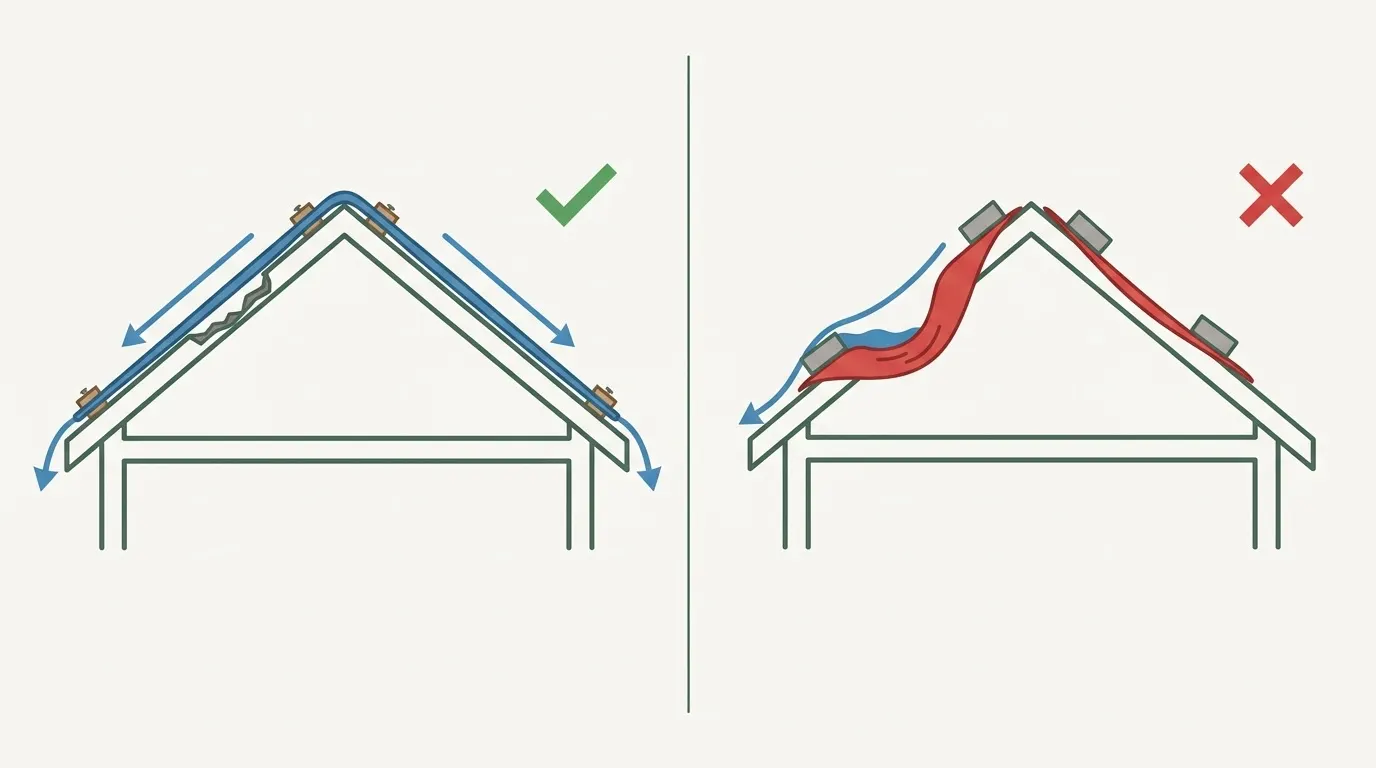
- ✓Over the ridgeThe top edge finishes on the opposite slope, so water cannot run under it.
- ✓Furring stripsScrewed through the tarp into the decking, and never through the low side.
- ✓Pulled tautA slack tarp collects water, and the weight tears it loose in the next storm.
- ✕Stops short, held down by weightBricks, tyres and sandbags let the top edge lift. Water runs straight underneath and into the opening you were trying to protect.
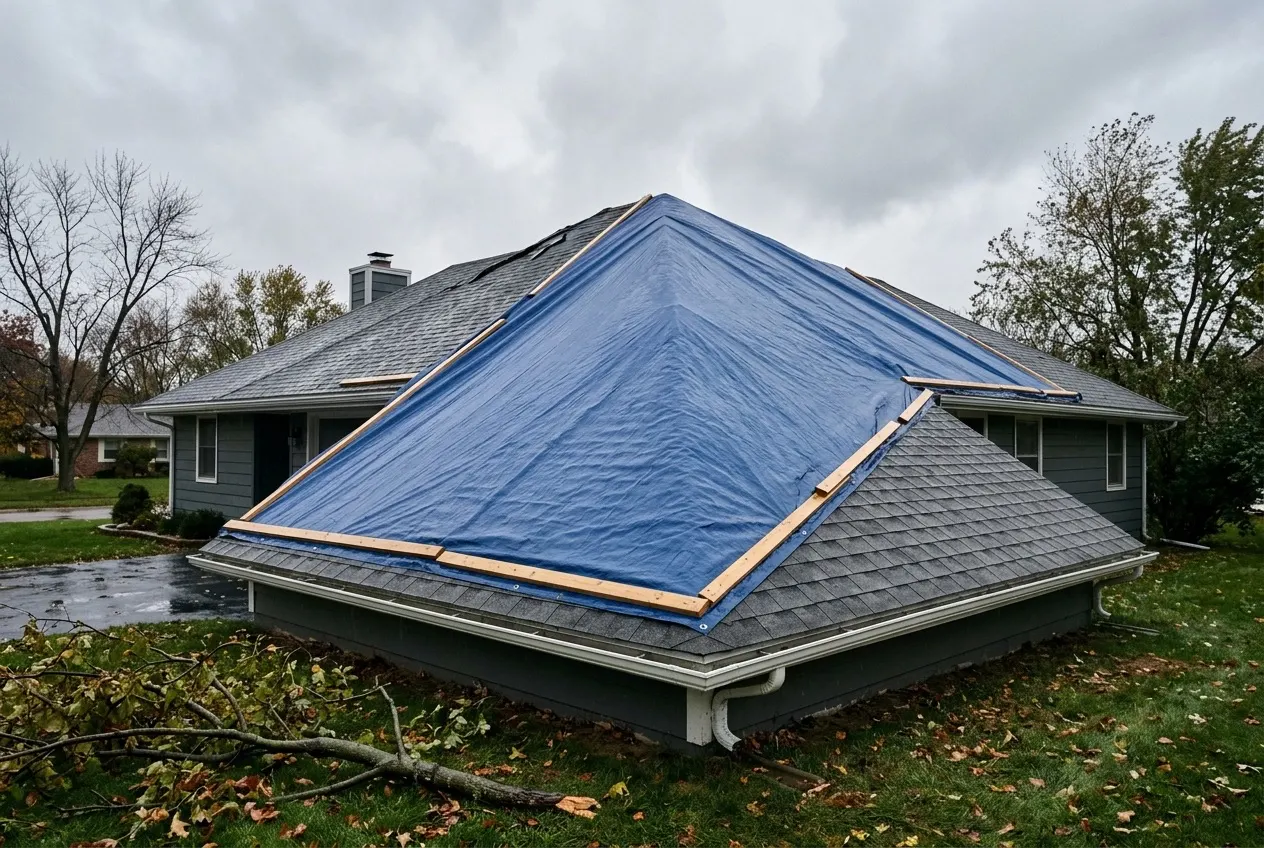
A correct emergency tarp:
- Runs over the ridge, so the top edge is on the opposite slope and water cannot get under it
- Is anchored with furring strips screwed through the tarp into the decking, not held down with bricks, tyres or sandbags
- Extends well past the damaged area on all sides, typically several feet
- Is pulled taut, because a slack tarp collects water and the weight tears it loose
- Has no fasteners through the low side, where every hole becomes a leak
You can tell a rushed tarp job from the ground: if it is flapping, pooling water, or held down by weight alone, it will not survive the next storm and may make things worse.
Expect 30 to 90 days of service life in Valdosta. Summer UV and heat here degrade polyethylene noticeably faster than in cooler regions. Tarps left through a whole season generally fail, and they tend to fail in weather, which is the worst possible time.
Honest triage: some things genuinely can wait
Not every roof problem is an emergency, and there is no reason to pay a night premium for something that will be identical in the morning.
Call now if water is actively coming in, a ceiling is sagging or bulging, there is a visible hole or missing section, a limb has come through, or water is anywhere near electrical fixtures.
The morning is fine for a damp stain with no active dripping and no rain in the forecast, missing shingles with dry weather ahead, a small amount of granule loss, or a gutter problem. These need fixing, but nothing about them changes overnight.
The one qualifier: check the forecast before deciding. A non-urgent problem with heavy rain arriving before morning becomes an urgent one.
After a major storm, expect a queue
This is the part worth setting expectations on, because it frustrates people who have never been through it.
A single severe event can damage thousands of roofs across Lowndes and neighbouring counties within an hour. The number of roofing crews in the area does not change. For the following several days, every roofer is triaging: open holes and active interior flooding get attention first, and lower-severity calls wait.
In that window, what you should realistically expect is a tarp, not a repair. Crews work through the backlog by stabilising as many properties as possible, then return to do permanent work in sequence. A contractor who promises a full permanent repair within 48 hours of a major regional storm is either not being straight with you, or is about to do the job badly on a wet deck.
Use the waiting time productively: photograph everything, file the claim, keep the damaged material, and get your documentation in order.
Emergency Roof Repair costs in Valdosta
What this work typically costs locally. Ranges are for planning, not quotes — the only accurate number comes from an inspection.
| Repair type | Typical Valdosta range | What moves the price |
|---|---|---|
| Emergency tarping (temporary) | $400 – $1,200 | Roof size, pitch, after-hours call-out |
| Single-point leak repair | $300 – $900 | Access, one entry point, no decking damage |
| Decking replacement | $70 – $150 per 4x8 sheet | Extent of rot, attic access |
Ranges reflect typical Valdosta-area pricing for single-story asphalt shingle roofs in accessible condition. Steep pitch, two-story access, hidden decking damage and after-hours calls all push costs higher.
Is this an emergency, or can it wait until morning?
Honest triage. Paying an after-hours premium for something that can wait costs you money for no benefit.
| Situation | Call now | Why |
|---|---|---|
| Water actively running or dripping inside | Yes | Every hour of intrusion adds drywall, insulation and flooring damage, and mould can begin within 24–48 hours |
| Ceiling sagging or bulging | Yes | Water is pooling behind the drywall and the ceiling may come down |
| Visible hole, missing section or limb through the roof | Yes | Open to the weather, and your policy's duty to mitigate is already running |
| Water near light fixtures or outlets | Yes | Electrical hazard — kill the circuit and get someone out |
| Damp stain, no active dripping, no rain forecast | Next business day | Nothing is getting worse overnight; you will pay an after-hours premium for no gain |
| Missing shingles, no leak, dry weather ahead | Next business day | Needs repair soon, but not tonight |
How it works
- Call, any hour Describe what is happening. We route it to a licensed local roofer who handles emergency call-outs.
- Phone triage Some situations can be stabilised by you in the next ten minutes, and a few genuinely cannot wait. You will be told honestly which this is.
- Stabilise the opening Tarping or a temporary patch to stop water getting in. This is about stopping the damage clock, not fixing the roof.
- Document for the claim Photographs of the damage and the temporary work, plus an itemised invoice — what an insurer needs to reimburse mitigation costs.
- Schedule the permanent repair Once the weather clears and the deck is dry. A permanent repair on wet sheathing traps moisture and fails.
Insurance claims
If your leak came from wind, hail, a fallen limb or a tropical system, it may be a covered claim rather than an out-of-pocket repair. Georgia policies generally cover sudden damage and exclude wear and age, and the documentation you gather in the first hour is usually what decides which side of that line your claim lands on.
Frequently asked questions
How much does emergency roof tarping cost in Valdosta?
Emergency tarping in Valdosta typically runs $400 to $1,200. Roof size, pitch and access drive most of the difference, and an after-hours or overnight call-out adds roughly $100 to $300. The cost is usually reimbursable under your policy's duty-to-mitigate provision, so keep the itemised invoice and photograph the tarp in place.
How quickly can someone get to my roof at night in Valdosta?
For an active leak, expect a roofer within a few hours on a normal night. After a significant regional storm that changes — every roofer in Lowndes County is working a queue, and calls get triaged by severity. Open holes and active interior flooding go first.
Should I put a tarp on my roof myself?
Generally no, and definitely not during a storm or at night. Wet asphalt shingles are extremely slick, storm-damaged decking may not hold your weight, and a tarp that is not properly anchored and run over the ridge can channel water into the building rather than away from it. More people are injured tarping a roof than by the leak they were trying to stop.
How long does an emergency tarp last?
A properly installed tarp — anchored with furring strips and run over the ridge — will typically hold for 30 to 90 days in Valdosta conditions. UV exposure and summer heat degrade the material faster here than in cooler climates. Treat it as a bridge to the permanent repair, not a solution. Tarps left through a full season usually fail, and often fail during the next storm.
Can a roof be permanently repaired at night or in the rain?
No. A permanent repair needs a dry deck, because sealing wet sheathing traps moisture underneath and causes rot and adhesion failure. What happens at night or during a storm is stabilisation — tarping or a temporary patch to stop the water. The real repair happens once the roof is dry.
What counts as a roofing emergency?
Water actively entering the building, a sagging or bulging ceiling, a visible hole or missing roof section, a limb through the roof, or water near electrical fixtures. A damp stain with no active dripping and no rain forecast is not an emergency — it needs attention in the next few days, but calling after hours for it means paying a premium for no benefit.
Do I pay more for an after-hours call in Valdosta?
Yes, typically $100 to $300 above the standard rate for nights, weekends and holidays. That premium is generally worth paying when water is actively coming in, because interior damage compounds by the hour and mould can start within 24 to 48 hours. It is not worth paying for a stain that has been there a fortnight.
Areas we cover
Valdosta and Lowndes County, plus surrounding towns. ZIP codes 31601, 31602, 31605, 31606, 31698.
Related guides
Roof Leak or Attic Condensation? How to Tell the Difference
In humid south Georgia, a real share of reported roof leaks are attic condensation. Same stain, same damp insulation, completely different fix — and roof repair will not solve it.
How Much Does Roof Leak Repair Cost in Valdosta, GA?
Most roof leak repairs in Valdosta run $300 to $900. Here is what sits behind that range, what pushes a job to the top of it, and the one variable that matters more than all the others.
Roof leaking in Valdosta?
Tell us what's happening and we'll put a licensed local roofer on it. Calls are answered around the clock.
Calling…
(229) 555-0100Tap to call againDidn't open? Dial (229) 555-0100. Have your ZIP code handy.